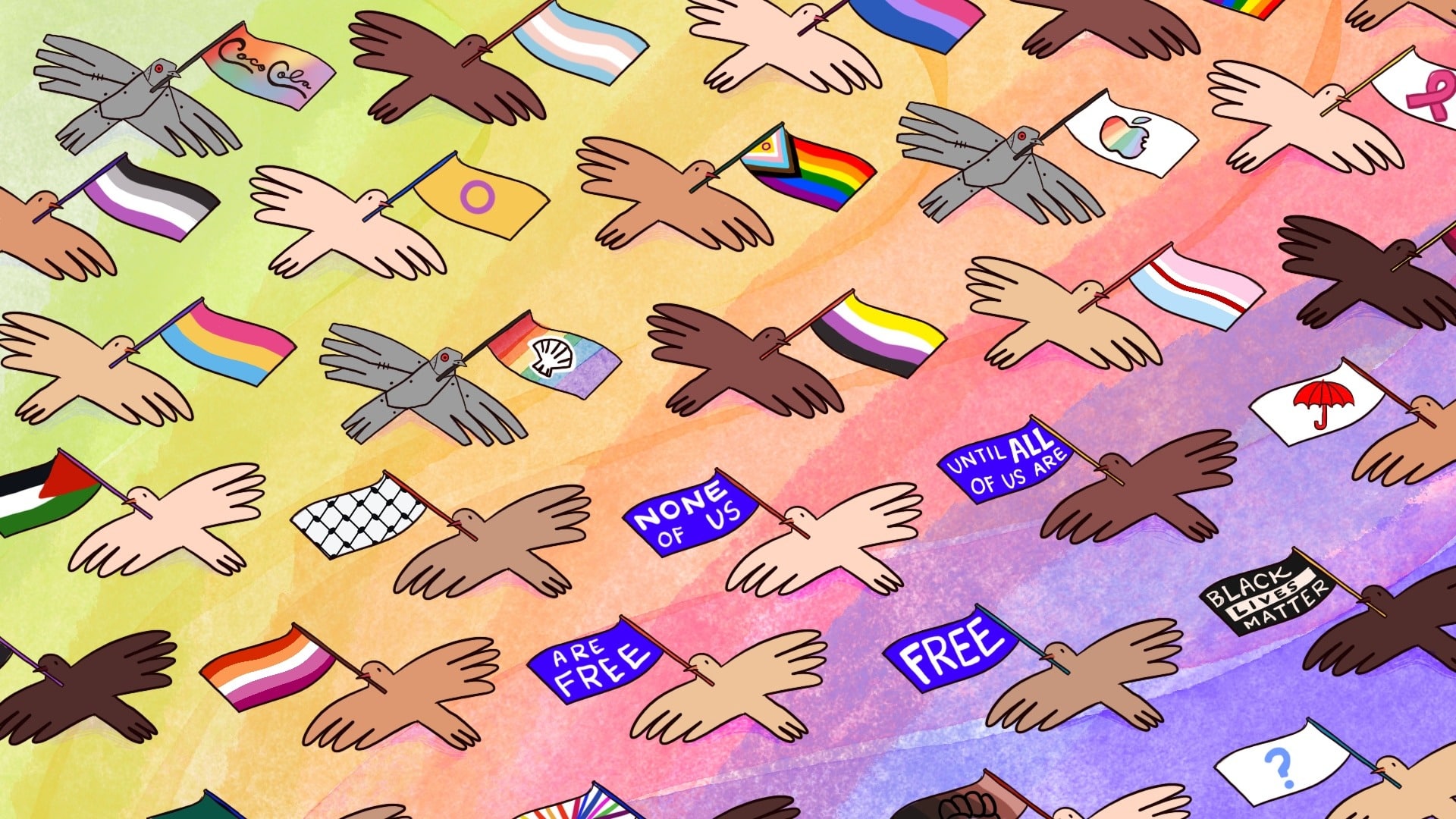
Illustration: Harjyot Khalsa, www.harjyotkhalsa.com
As Pride celebrations grow and proliferate, they often become sites of controversy: What is being celebrated—the diversity of the community or just the visibility of a select few? Who gets to take part in this celebration, and who is left out or sidelined? From corporate sponsorships to grassroots protests, author Ahmed Awadalla examines the ever-evolving landscape of LGBTIQ+ Pride in Germany.
Berlin stands apart. If you ask someone in the city about attending a Pride event, they’ll likely respond with another question: „Which one?“ This is the essence of Berlin—a metropolis that hosts a multitude of queer marches and initiatives, each with its own distinct priorities and vision of the LGBTIQ+ experience. In a city this vast, with its diverse communities and subcultures, there’s always a space where one can feel seen—or at least, it seems that way.
Having lived in Berlin for years, I’ve witnessed the Pride landscape shift and evolve, with each event embodying a different interpretation of queerness. What first stood out to me during my early summers in the city was the name „Christopher Street Day“ (CSD)—a direct reference to the American Stonewall Riots. These riots erupted in response to persistent police harassment following a raid on a New York bar. Although a pivotal moment in queer history, the choice felt curious, if not a little dissonant, considering Germany’s deep history of advocacy for queer rights.
Naturally, when I first arrived in Berlin, I was eager to join a queer march in the hope of finding community and connection. My first march wasn’t a typical Pride event but a protest organized by Nasser Al-Ahmad, a young Lebanese man who faced brutal violence from his family after coming out. The march began outside a mosque in Neukölln to challenge the role of religious institutions in promoting homophobia. Despite Nasser’s efforts to emphasize that homophobia wasn’t just “a Muslim problem,” media coverage framed the issue as a clash between queer and migrant communities, pitting them against each other.
As I marched, I quickly noticed how out of place I felt in the predominantly white crowd. At one point, a woman asked me to move aside, assuming I wasn’t part of the protest, likely because of my appearance. This made me question my own belonging in a space that was supposed to be about solidarity and plurality. It highlighted the uncomfortable reality that even within queer spaces, not everyone feels welcomed or understood. Different people I spoke to had their own take on what Pride means to them. For some, it feels like home, while for others, it remains a space where their struggles are made invisible.
Between Celebration and Commercialization
The first German CSD took place in Berlin in 1979, inspired by American Pride events but soon adapted to local politics. What began as passionate protests for LGBTQ+ rights has, over time, turned into something much more mainstream and commercialized. Big companies and political parties now play a more significant role. This trend is part of a larger pattern called “rainbow capitalism,” where businesses use LGBTQ+ symbols and slogans for profit, while urgent issues facing the community, especially those on its margins, are pushed aside.
“Honestly, I couldn’t stand it,” said Mahdi, a community member who left CSD Berlin this year after just 10 minutes. “Pharma companies, banks, and internet giants—what do they have to do with our struggle?” Mahdi’s frustration is palpable. For him, the sight of straight people occupying corporate floats felt like another layer of erasure. “I get that allies are important, but they need to be mindful of the space they take up,” Mahdi added, reflecting a common sentiment among those who feel mainstream Pride has lost its way.
But not everyone shares this sense of alienation. “For me, my reasons for going to CSD are two-fold,” said Cameron, a regular CSD attendee. “The principles of Pride are still very worthy. It’s a day where we can celebrate our LGBTQ+ identities and reflect on how we’re not just tolerated but accepted and even celebrated by wider society.” Cameron acknowledges the criticisms about corporate influence but admits that, for him, it doesn’t overshadow the event’s value. “Yes, the parade has been hijacked by corporate interests, but the party atmosphere—dancing in the rain to Spice Girls with queer folks from all over the world—is still magical. It’s just fun!”
Cameron recognizes his own privilege within these spaces. “I haven’t felt excluded because I fit the classic stereotype of a white gay male. I can see why others might feel less represented,” he admitted. Hassan, a gay man of color, shares Cameron’s sentiment: “My birthday aligns with CSD Berlin, so my friends visit me from other cities, and we get to experience this collective joy, dressing however we want. It’s a time to truly celebrate together.”
Tensions Under the Rainbow
While some are disillusioned by Pride’s shift away from its radical roots, others appreciate it as a space for self-acceptance. But this raises a fundamental question: Should Pride be about identity or action? Is it enough to reclaim our identities as a response to the shame society imposes, or should Pride be about taking meaningful steps toward change? And if so, what kind of action?
These debates aren’t new. In the 1990s, the group Gay Shame emerged in the U.S. to challenge the focus on identity and visibility over activism. They argued that simply transforming shame into pride wasn’t enough without confronting systemic oppression through tangible actions like supporting trans rights and fighting against economic inequality. Their stance echoed the message: “None of us is free until all of us are free.”
In Berlin, I found a similar spirit at Alternative CSD (Kreuzberg Pride), which rejected corporate sponsorship and focused on grassroots activism, taking on issues like poverty and gentrification. But internal conflicts eventually led to its end, showing that even in activist spaces, disagreements can break down solidarity. After a hiatus, Internationalist Queer Pride emerged in 2021 with a bold political stance that demands revolutionary action to dismantle all forms of oppression. They advocate for environmental justice, decriminalizing sex work, supporting Indigenous and migrant rights, and abolishing border regimes
“It’s empowering to see so many diverse groups coming together for a bigger cause,” says Andreas, a cis white queer man who attended this year’s Internationalist Queer Pride (IQP). However, he adds, “This year’s event was traumatic for many participants due to the police’s excessive use of violence.” For Andreas, this repression is reminiscent of the early days of queer activism, like the Stonewall riots, when police were viewed as a threat, not allies. This controversy around the police’s role is also present on a global scale. For example, Pride Toronto banned police participation following concerns about police brutality and racial profiling raised by the Black Lives Matter movement.
Dozens of arrests were reported during Internationalist Queer Pride (IQP) this year, directly linked to one of the most contentious issues in Germany: the ongoing atrocities in Palestine. Demonstrations in solidarity with Palestinian communities have frequently faced severe police crackdowns, viewed as an unprecedented restriction of free speech. Germany’s stance is often framed through the concept of Staatsräson, which reflects the country’s commitment to protecting Israel’s security due to historical responsibility for the Holocaust. Critics argue that this has translated into unconditional support for Israeli violations of international law.
The Dyke* March and The Persistence of Patriarchy
The Dyke* March, which began in the 1990s to promote lesbian visibility, has since expanded to include women, trans, and non-binary individuals. Cisgender men are asked not to participate, creating a space where these voices and experiences are centered without being overshadowed. Like Kreuzberg Pride, the Dyke* March remains focused on activism and intersectionality, resisting the trend towards commercialization. However, police violence was also reported at this year’s Dyke* March, on the backdrop of Palestinian solidarity.
Two people I talked to have been regularly attending the Dyke* March. Sarah thinks that patriarchy is still a problem within the queer community and that it manifests in how many queer spaces cater primarily to the male experience. “Yes, there are more FLINTA* spaces and events now, but it’s still not enough,” she said. “We need to keep pushing for real change, not just more visibility.” Mar, who identifies as non-binary, also finds it important to attend: “I can be read as a cis male because of my appearance, but I think building a shared understanding shouldn’t be based solely on appearance. The experiences of not feeling safe in our bodies and in public spaces are significant things we should come together based on.”
Right-Wing Return and the Full Circle
While the tensions between police and demonstrators in Berlin may seem like a historical throwback to the early days of activism, another issue warrants serious attention. In 2024, right-wing groups in Germany have increasingly targeted Pride events, particularly in East Germany. These anti-CSD marches are part of a broader trend of rising nationalism and xenophobia in the country. Although images of neo-Nazis in places like Bautzen have generated significant concern on social media, a persistent narrative in German politics portrays homophobia, transphobia, and anti-Semitism as problems imported from elsewhere. This downplays the actual threat posed by right-wing groups that have demonstrated their presence both on the streets and within the German parliament.
There is no better lesson than the one we are learning now: we must understand issues of xenophobia and injustices related to gender and sexuality as inseparable. With the current existential threats, Pride seems to have come full circle, and we must confront the question of what it means to gather collectively and for what purpose.